 AWS VCPU Account's
 Aws Ai Account
 AWS RPM Account Kiro supported
.webp) Aws SES open port Account
Aws SES open port Account
 Aws Bedrock account
.webp) Buy AWS Cloud Shell
Buy AWS Cloud Shell
 Aws Credit Accounts
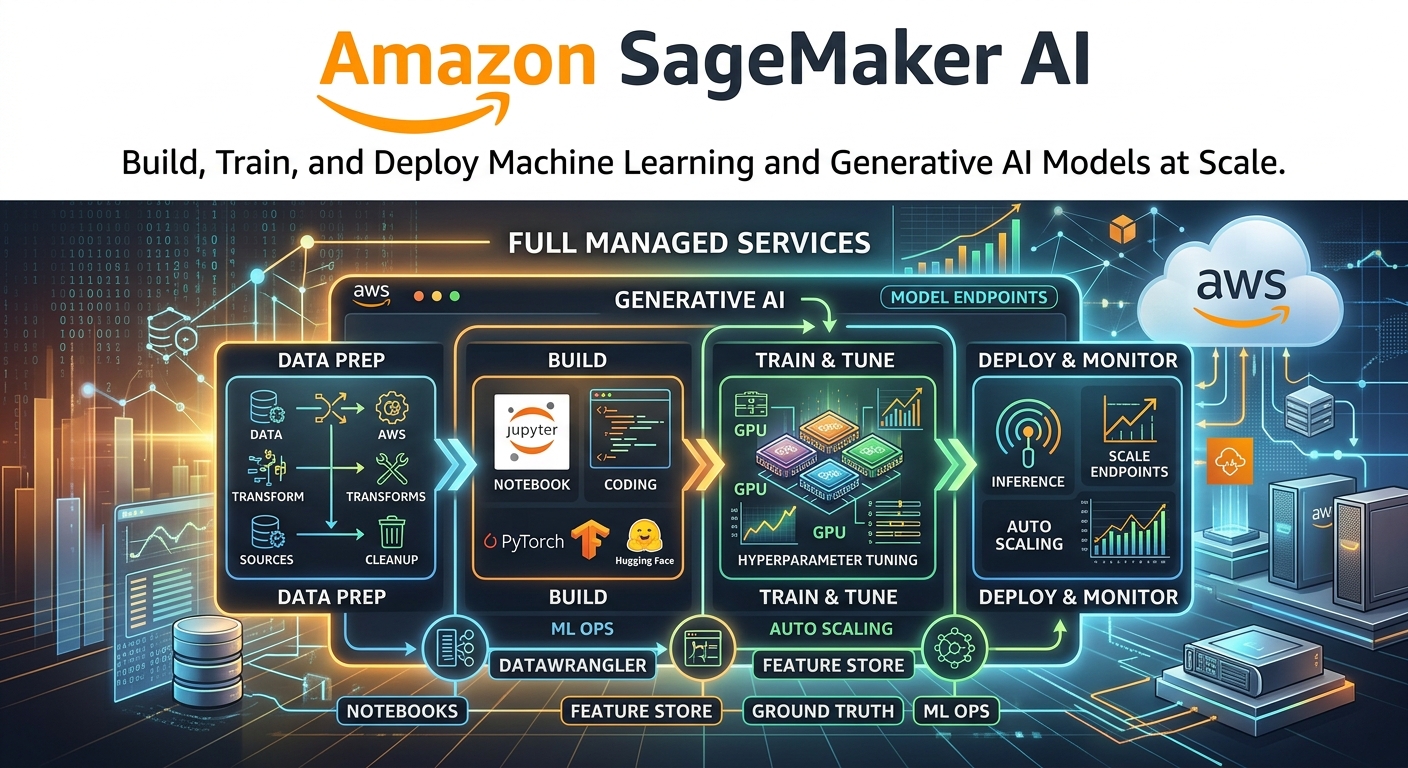
Amazon SageMaker AI is a fully managed cloud service from Amazon Web Services (AWS) that provides developers, data scientists, and ML engineers with the tools needed to build, train, tune, deploy, and monitor machine learning (ML) and Generative AI models at scale.
Instead of manually setting up physical servers, configuring software drivers, or managing complex distributed compute clusters, SageMaker abstracts away the underlying infrastructure so teams can focus on model development.
Core Architecture: The Three-Stage Workflow
SageMaker operates on an end-to-end Machine Learning Lifecycle split into three main stages: Build, Train, and Deploy.
  ┌─────────────────────────────────────────────────────────────┐
  │                      1. BUILD                               │
  │  Data Prep (Data Wrangler) -> Labeling (Ground Truth)       │
  │  Development (SageMaker Studio / Jupyter Notebooks)         │
  └──────────────────────────────┬──────────────────────────────┘
                                 │
                                 ▼
  ┌─────────────────────────────────────────────────────────────┐
  │                      2. TRAIN                               │
  │  Data from S3 -> Managed Compute Instances / Docker Containers │
  │  Auto Hyperparameter Tuning & Debugging -> Model Artifacts   │
  └──────────────────────────────┬──────────────────────────────┘
                                 │
                                 ▼
  ┌─────────────────────────────────────────────────────────────┐
  │                      3. DEPLOY & MONITOR                    │
  │  Inference Endpoints (Real-time, Serverless, Async, Batch)  │
  │  Performance & Drift Tracking (Model Monitor)               │
  └─────────────────────────────────────────────────────────────┘
How Amazon SageMaker AI Works (Step-by-Step)
1. Build Phase (Data Preparation & Modeling)
- Data Labeling (SageMaker Ground Truth): Helps generate accurately labeled training datasets using automated machine learning alongside human annotators.
- Data Preparation (SageMaker Data Wrangler): Allows data scientists to aggregate, clean, transform, and visualize data from over 50 sources with minimal code.
- Integrated Development Environment (SageMaker Studio & Notebooks): Provides managed JupyterLab environments pre-configured with deep learning frameworks (TensorFlow, PyTorch, Hugging Face, Scikit-learn).
- SageMaker JumpStart & Autopilot: Offers access to pre-trained Foundation Models (LLMs for Generative AI) and automated machine learning (AutoML) capabilities to train models automatically from raw data.
2. Train Phase (Distributed Compute & Fine-Tuning)
When a training job is executed, SageMaker spins up ephemeral compute instances behind the scenes:
- Ephemeral Provisioning: SageMaker provisions the requested EC2 compute instances (e.g., GPU or Trainium instances), downloads the training code via Docker containers, pulls training data from Amazon S3, and starts training.
- Distributed Training: For massive datasets or Foundation Models, SageMaker automatically splits models and data across hundreds of GPUs or nodes.
- Hyperparameter Tuning: Automatically runs hundreds of training jobs to find the optimal combination of hyperparameter settings for peak accuracy.
- Managed Spot Instances: Reduces training costs by up to 90% by utilizing unused AWS compute capacity while handling spot interruptions gracefully.
- Auto-Teardown: Once training finishes, the model artifacts are saved to Amazon S3, and the compute instances are automatically terminated so you only pay for exact compute time.
3. Deploy & Monitor Phase (Inference)
Once a model is trained, SageMaker hosts it behind secure REST API endpoints.
| Deployment Mode | Best For | Behavior & Cost |
| Real-Time Inference | Low-latency applications (e.g., live fraud detection) | Always-on, autoscaling endpoints. |
| Serverless Inference | Intermittent or unpredictable traffic patterns | Scales automatically from zero; pay only per request. |
| Asynchronous Inference | Large payloads, long-running queries (e.g., high-res image generation) | Queues incoming requests; processes in background. |
| Batch Transform | Periodic, non-real-time predictions on huge datasets | Runs a job over an entire dataset, saves to S3, and shuts down compute. |
- SageMaker Model Monitor: Continuously tracks model predictions in production to detect "concept drift" or "data drift" (when real-world data deviates from training data) and alerts developers to trigger retraining.
Primary Use Cases
- Generative AI & LLMs: Fine-tuning and hosting open-weight Large Language Models (e.g., Llama, Mistral) on custom data.
- Fraud & Risk Detection: Real-time transaction scoring for financial institutions.
- Recommendation Engines: Powering personalized product recommendations in e-commerce and streaming media.
- Predictive Maintenance & Forecasting: Forecasting inventory demand or predicting hardware failures using historical time-series data.